 Add to Chrome
 Add to Firefox
 Add to Edge
Knowledge Diversion for Efficient Morphology Control and Policy Transfer
Dec 10, 2025
Universal morphology control aims to learn a universal policy that generalizes across heterogeneous agent morphologies, with Transformer-based controllers emerging as a popular choice. However, such architectures incur substantial computational costs, resulting in high deployment overhead, and existing methods exhibit limited cross-task generalization, necessitating training from scratch for each new task. To this end, we propose \textbf{DivMorph}, a modular training paradigm that leverages knowledge diversion to learn decomposable controllers. DivMorph factorizes randomly initialized Transformer weights into factor units via SVD prior to training and employs dynamic soft gating to modulate these units based on task and morphology embeddings, separating them into shared \textit{learngenes} and morphology- and task-specific \textit{tailors}, thereby achieving knowledge disentanglement. By selectively activating relevant components, DivMorph enables scalable and efficient policy deployment while supporting effective policy transfer to novel tasks. Extensive experiments demonstrate that DivMorph achieves state-of-the-art performance, achieving a 3$\times$ improvement in sample efficiency over direct finetuning for cross-task transfer and a 17$\times$ reduction in model size for single-agent deployment.

Data Augmentation for Environmental Sound Classification Using Diffusion Probabilistic Model with Top-k Selection Discriminator
Apr 04, 2023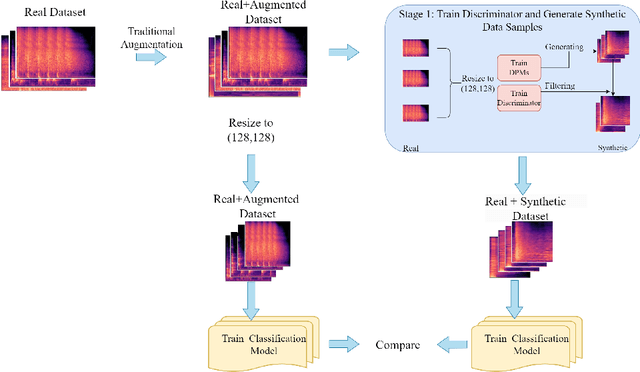

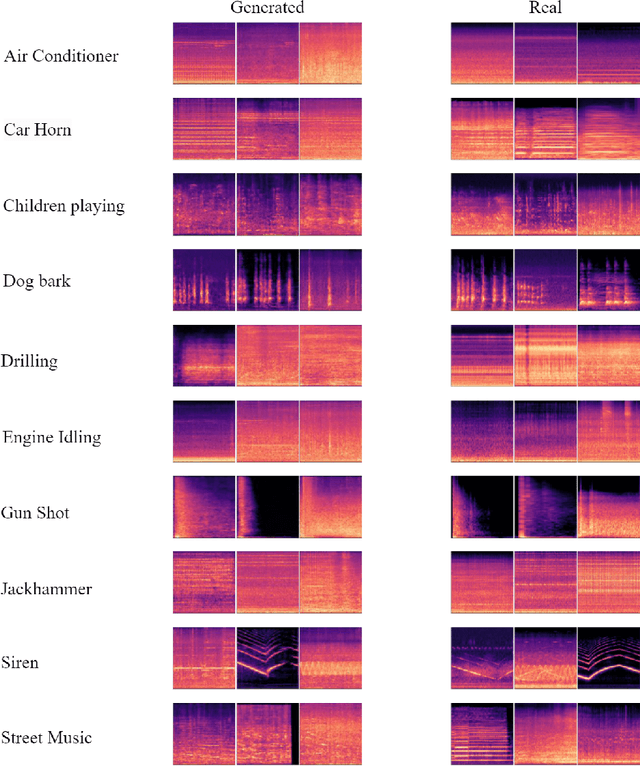
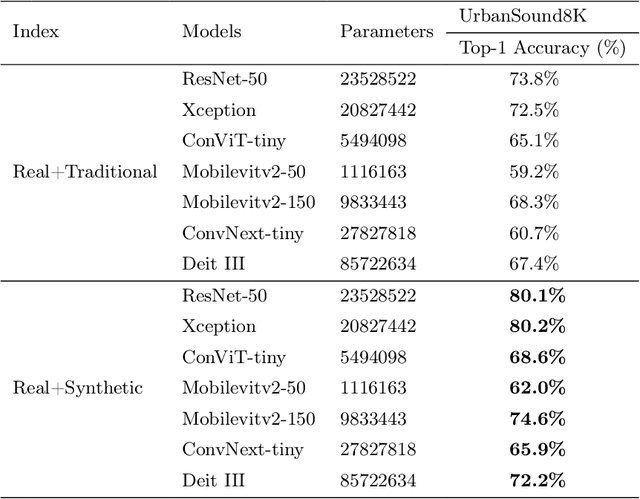
Despite consistent advancement in powerful deep learning techniques in recent years, large amounts of training data are still necessary for the models to avoid overfitting. Synthetic datasets using generative adversarial networks (GAN) have recently been generated to overcome this problem. Nevertheless, despite advancements, GAN-based methods are usually hard to train or fail to generate high-quality data samples. In this paper, we propose an environmental sound classification augmentation technique based on the diffusion probabilistic model with DPM-Solver$++$ for fast sampling. In addition, to ensure the quality of the generated spectrograms, we train a top-k selection discriminator on the dataset. According to the experiment results, the synthesized spectrograms have similar features to the original dataset and can significantly increase the classification accuracy of different state-of-the-art models compared with traditional data augmentation techniques. The public code is available on https://github.com/JNAIC/DPMs-for-Audio-Data-Augmentation.